 BuckleUpLaws
Does My 10-Year-Old Still Need a Booster Seat?
If your child has turned 10, you may be wondering whether it is finally time to put the booster seat away. Perhaps your child feels too old for one, their friends no longer use boosters, or they seem tall enough to wear a regular seat belt.
But does a 10-year-old still need a booster seat?
Yes, many 10-year-olds still need a booster seat because the adult seat belt does not fit their bodies properly yet. Age alone does not determine whether a child is ready to stop using a booster. Height, body proportions, vehicle seat design, and the child’s ability to sit correctly throughout the ride all matter.
The American Academy of Pediatrics (AAP) recommends using a belt-positioning booster until the vehicle’s seat belt fits properly, typically when children are around 4 feet 9 inches tall and between 8 and 12 years old.
In this guide, we’ll explain how to check whether your 10-year-old still needs a booster, what the five-step seat belt fit test involves, and how state laws affect your decision.
Does a 10-Year-Old Still Need a Booster Seat?
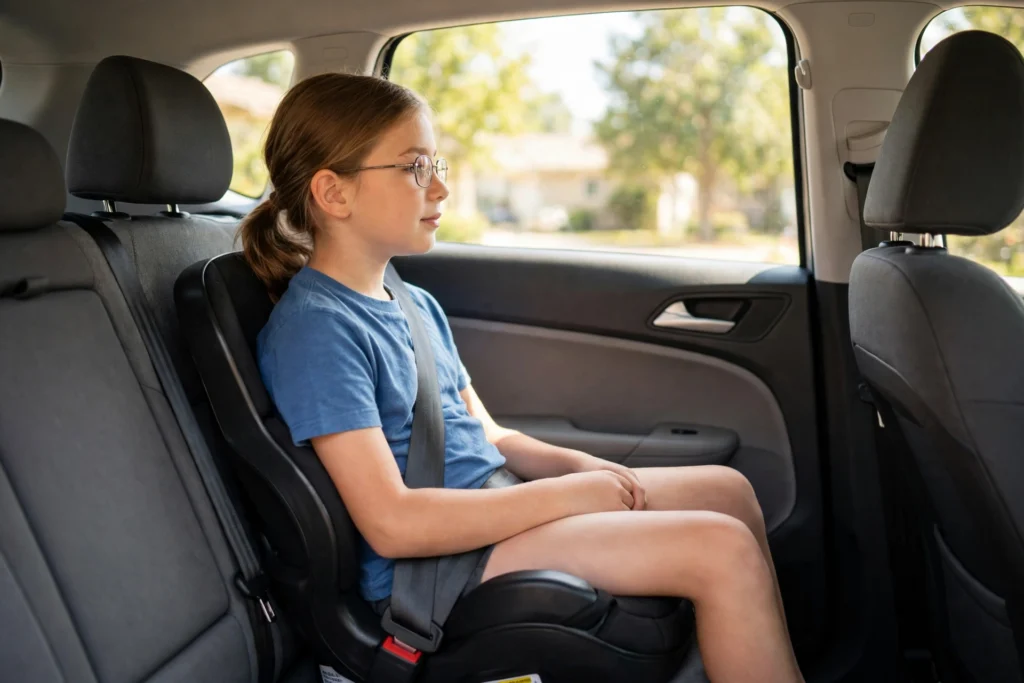
Yes, if the vehicle’s adult seat belt does not fit correctly, your 10-year-old should continue using an appropriate booster seat.
Many children do not fit most vehicle seat belts properly until they are between 10 and 12 years old. Some are ready earlier, while others need a booster for longer.
The important question is not whether your child looks old enough. It is whether the seat belt can safely restrain their body in your particular vehicle.
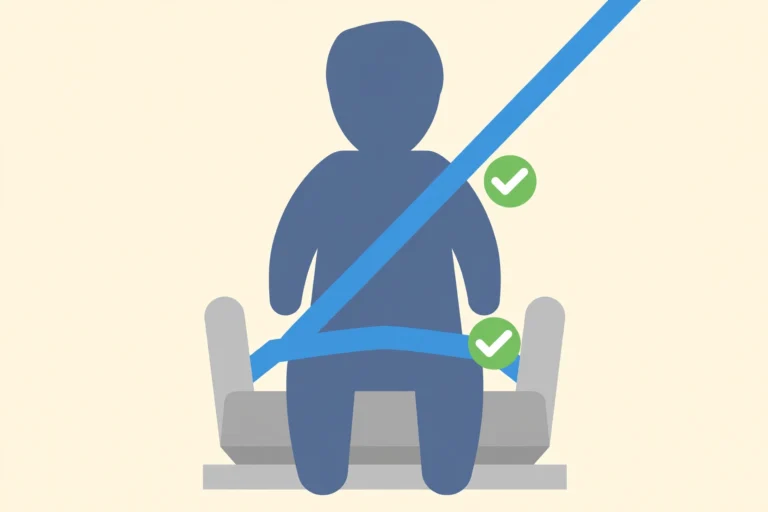
A booster raises the child so the lap belt rests low across the upper thighs and the shoulder belt crosses the middle of the chest and shoulder. Without a booster, a smaller child may experience the lap belt riding up onto the abdomen or the shoulder belt crossing the neck.
These are signs that the seat belt may not fit properly.
The National Highway Traffic Safety Administration (NHTSA) recommends that children ages 8–12 continue using a booster until they are large enough for an adult seat belt to fit correctly. Children should also ride in the back seat because it offers important safety advantages.
You can read the official recommendations in the NHTSA car seat and booster seat safety guide.
How Tall Should a 10-Year-Old Be to Stop Using a Booster?
A commonly used guideline is approximately 4 feet 9 inches tall, or 57 inches. Many children reach this height between ages 8 and 12, but the timing varies.
Reaching 4 feet 9 inches does not automatically mean that your child is ready to use a regular seat belt. The vehicle’s seat depth and belt positioning also affect the fit.
Likewise, a 10-year-old who is shorter than 4 feet 9 inches should not automatically be assumed to need a booster without checking the specific circumstances and applicable law. For safety, assess all five elements of seat belt fit and follow the booster manufacturer’s instructions.
Here is a simple way to think about the decision:
- Your child is 10 and shorter than 4 feet 9 inches: A booster will often still be needed. Check the belt fit and your state’s requirements.
- Your child is 10 and around 4 feet 9 inches: Check all five seat belt fit criteria before transitioning.
- Your child is 10 and taller than 4 feet 9 inches: Height alone is not enough. Confirm that the belt fits correctly and that your child can maintain the proper position.
- Your child is 10 but cannot sit correctly throughout the trip: Continue using an appropriate booster, provided it is suitable for the child’s size and vehicle.
The goal is not to stop using a booster on a particular birthday. It is to make sure your child is properly restrained on every journey.
Read More About: 5-Step Test Booster Seats: Is Your Child Ready to Use a Seat Belt?
The 5-Step Seat Belt Fit Test for a 10-Year-Old
Before removing your child’s booster seat, check how the vehicle’s seat belt fits when your child sits directly on the vehicle seat.
This assessment is commonly called the five-step test. If your child fails any step, a booster may still be necessary.
1. Can Your Child Sit All the Way Back?
Ask your child to sit with their bottom against the back of the vehicle seat and their back resting naturally against the seatback.
If your child has to slide forward or slouch to get comfortable, the seat may be too deep for their current body size.
2. Do Their Knees Bend Comfortably at the Seat Edge?
With their back against the seatback, your child’s knees should bend naturally over the front edge of the vehicle seat.
If their legs are too short and they have to slide forward, the belt may move away from its proper position.
3. Does the Shoulder Belt Cross the Middle of the Chest and Shoulder?
The shoulder belt should rest snugly across the middle of the shoulder and chest.
It should not cross the neck or face, fall off the shoulder, or be tucked behind the child’s back or under their arm.
4. Does the Lap Belt Sit Low Across the Upper Thighs?
The lap belt should sit low and snug across the hips and upper thighs, not across the soft abdomen.
If it rides up onto your child’s stomach, continue using an appropriate booster and reassess the fit.
5. Can Your Child Stay in the Correct Position for the Entire Trip?
Your child must be able to remain seated correctly without slouching, leaning forward, or moving the belt out of position.
A child who passes the first four steps but cannot maintain the correct position during a journey is not ready to rely on an adult seat belt alone.
All five steps matter. If even one step fails, continue using a suitable booster and repeat the assessment as your child grows.
Why a Booster Seat Still Matters at Age 10
Parents sometimes assume that a booster seat is no longer useful once a child reaches elementary school or begins approaching their teenage years. However, vehicle seat belts are designed primarily around adult body proportions.
A 10-year-old may be tall enough to reach the seat belt buckle but still too small for the lap and shoulder belts to fit properly.
A booster helps address that difference by raising the child into a position where the vehicle’s existing restraint system can work as intended.
Better Lap Belt Positioning
When a child is too small for the vehicle seat, the lap belt may cross the abdomen instead of sitting low across the hips and upper thighs.
A correctly used booster can help position the belt lower, reducing the risk of harmful belt loading on the abdomen in a crash.
Better Shoulder Belt Positioning
A booster can also help the shoulder belt cross the chest and shoulder rather than the neck or face.
If the belt feels uncomfortable, children may be tempted to move it behind their backs or under their arms. These positions can compromise protection.
More Consistent Seating Position
Some children naturally slouch, lean forward, or move around when they become uncomfortable. A properly selected booster can help position a child appropriately, although the child must still remain seated correctly.
For additional guidance, see our guide to booster seat requirements explained.
What Are the Booster Seat Laws for 10-Year-Olds?
Booster seat laws vary by state. Some states set requirements primarily by age, while others also use height or weight thresholds. Certain laws specify when a child can legally transition to an adult seat belt.
That means there is no single nationwide rule saying every 10-year-old must use a booster, or that every 10-year-old can legally stop using one.
For example, a state may permit an adult seat belt at a particular age, but safety recommendations may still favor a booster if the belt does not fit properly.
It is important to distinguish between the legal minimum and the safest choice for your child.
Why You Should Check Your State’s Rules
Before changing your child’s restraint, find out:
- The minimum age or height requirements for child restraints in your state.
- Whether the law specifies when a booster seat is required.
- Whether separate requirements apply to front-seat passengers.
- Whether recent legislative changes have affected the rules.
Because state laws can change, use a current, state-specific source instead of relying on a general age chart that may be outdated.
You can start with our Booster Seat Requirements by State guide to review the rules that apply to your family.
For legal confirmation, consult your state’s official transportation agency or current statutes.
Can a 10-Year-Old Sit in the Front Seat Without a Booster?
The booster seat decision and the front-seat decision are two separate issues.
Even if your 10-year-old passes the seat belt fit test, the child should generally remain in the back seat. The American Academy of Pediatrics recommends that children younger than 13 ride in the rear seats.
Front passenger airbags can pose additional risks to younger children, particularly when they are seated too close to the dashboard.
A properly fitting seat belt does not automatically mean that a child is ready to sit in the front.
Follow your vehicle owner’s manual and your state’s laws, and keep your child in the back seat whenever possible.
What If My 10-Year-Old Refuses to Use a Booster?
It is common for older children to feel embarrassed about using a booster, especially when their friends have stopped using one.
Try explaining that booster seats are not about age or maturity. They help the vehicle’s seat belt fit a child’s body properly.
Here are a few ways to make the conversation easier:
Explain the reason simply. Show your child where the lap and shoulder belts should sit and explain why correct positioning matters.
Let your child participate. If a new booster is appropriate, involve them in choosing a comfortable model that meets the manufacturer’s requirements.
Avoid comparisons with friends. Children grow at different rates, and different vehicles have different seat belt geometry.
Set a consistent rule. Make it clear that every passenger must be properly restrained on every trip, even on short journeys.
Recheck the fit periodically. As your child grows, repeat the five-step test so the transition is based on actual fit rather than guesswork.
If your child is still within the appropriate limits for a booster, continuing to use it is a sensible safety decision.
High-Back or Backless Booster: Which Is Better for a 10-Year-Old?
Both high-back and backless booster seats can be suitable for older children when used correctly.
A high-back booster includes a backrest and may provide additional head support or shoulder belt guidance. It can be useful when the vehicle seat does not provide adequate head support or when the child needs help achieving correct belt positioning.
A backless booster is generally more compact and portable, but it relies on the vehicle seat and head restraint to provide adequate support.
Neither style is automatically better in every vehicle. The best option is the one that is approved for your child’s height and weight, fits the vehicle seating position, and positions the seat belt correctly.
Always check the booster and vehicle manuals before switching styles.
Common Mistakes to Avoid When Transitioning Out of a Booster
Several common mistakes can undermine an otherwise sensible decision.
Stopping at age 10 without checking belt fit. Your child’s birthday does not determine whether the belt fits correctly.
Relying on height alone. The 4-foot-9-inch guideline is useful, but the five-step test remains important.
Allowing the shoulder belt behind the back. This leaves the upper body inadequately restrained and should never be used as a workaround.
Ignoring the lap belt. A shoulder belt that looks comfortable does not make up for a lap belt positioned across the abdomen.
Forgetting that vehicles differ. Repeat the fit assessment if your child rides in another car or seating position.
Confusing legal compliance with best practice. A child may meet a state’s minimum legal requirement but still benefit from a booster because the belt does not fit properly.
Frequently Asked Questions
Does my 10-year-old still need a booster seat?
Many 10-year-olds do. If the adult seat belt does not fit properly across the upper thighs, chest, and shoulder, continue using an appropriate booster. Check your state’s legal requirements as well.
Is a 10-year-old too old for a booster seat?
No. Age 10 is within the typical 8–12-year range when many children are still transitioning from boosters to adult seat belts. Safety depends on proper fit, not whether a child looks too old for one.
Can my 10-year-old use a seat belt if they are 4 feet 9 inches tall?
Possibly, but height alone does not guarantee correct fit. Check all five steps and confirm the applicable legal requirements before removing the booster.
When can a child stop using a booster seat?
A child can transition when the vehicle’s seat belt fits properly without a booster, and the child can maintain the correct position throughout the journey. Many children are not ready until around ages 10–12.
Do booster seat laws differ by state?
Yes. State requirements vary, and legal rules can change. Check the current rules for your state before making a decision.
Should my 10-year-old sit in the back seat?
Yes, the back seat is generally the safest place for children. The American Academy of Pediatrics recommends that all children younger than 13 ride in the rear seats.
Final Thoughts: Keep the Booster Until the Seat Belt Fits
If you are asking whether your 10-year-old still needs a booster seat, the answer depends on how the seat belt fits—not simply on age.
Many children at this stage still need a booster to keep the lap belt low across the upper thighs and the shoulder belt across the chest and shoulder. Use the five-step fit test, follow the booster manufacturer’s instructions, and repeat the assessment as your child grows.
Remember that state laws establish legal requirements, while child passenger safety recommendations help parents make informed choices beyond those minimums.
To learn more about the requirements where you live, visit Buckle Up Laws.