 BuckleUpLaws
The 4’9″ Rule for Booster Seats: Why Does Height Matter?
Many parents have heard that a child should be around 4 feet 9 inches tall before switching from a booster seat to a regular seat belt. But why is this particular height so commonly recommended? Is it a legal requirement, a safety guideline, or simply an estimate?
The 4-foot-9-inch rule for booster seats is widely used because many children don’t fit adult seat belts correctly until they reach about this height. An adult seat belt may cross a smaller child’s neck or abdomen instead of resting across the stronger parts of the body.
However, height alone does not determine whether a child is ready to stop using a booster. Their body proportions, vehicle seat, seat belt position, and ability to remain seated all matter.
In this guide, we’ll explain why 4 feet 9 inches is used as a benchmark, how to check seat belt fit, and what parents should know about booster seat laws. Let’s go!!
What Is the 4’9″ Rule for Booster Seats?
The 4’9″ rule refers to a common child passenger safety guideline: children often need a booster seat until they are approximately 4 feet 9 inches tall, or 57 inches (about 145 cm), and can wear the vehicle’s adult seat belt correctly.
The American Academy of Pediatrics (AAP) recommends that children who have outgrown their forward-facing car seats use a belt-positioning booster until the vehicle’s lap-and-shoulder belt fits properly. This typically happens when children are around 4 feet 9 inches tall and between 8 and 12 years old.
The National Highway Traffic Safety Administration (NHTSA) gives similar guidance, emphasizing correct seat belt fit rather than age alone.
You can review the recommendations in the AAP’s booster seat guidance and the NHTSA seat belt safety guide.
The important distinction: 4 feet 9 inches is a general safety benchmark, not a guarantee that every child is ready for a seat belt alone. It is also not a universal legal cutoff for every state.
Why Is 4 Feet 9 Inches the Recommended Height?
The reason comes down to body proportions and how vehicle seat belts are designed to fit.
Most vehicle seat belts are designed primarily around adult body sizes. A younger child may be tall enough to buckle up but still too small for the lap and shoulder portions to sit in the correct places.
1. The Lap Belt Needs to Sit Low on the Hips
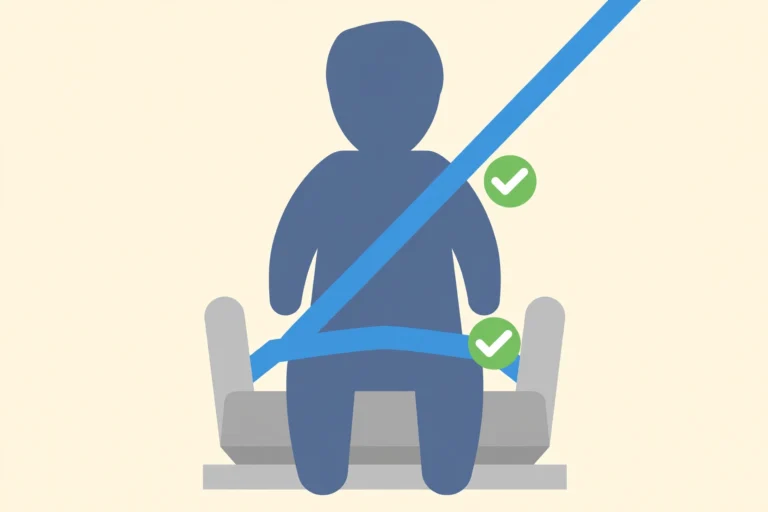
The lap portion of the seat belt should lie low and snug across the upper thighs and hips, rather than crossing the soft abdomen.
If a child is too small for the vehicle seat, the lap belt may ride up toward the stomach. In a crash, that position can increase the risk of abdominal injury.
A booster raises the child so the lap belt can sit lower across the body.
2. The Shoulder Belt Must Cross the Chest Correctly
The shoulder belt should cross the middle of the chest and shoulder. It should not rub against the neck, cross the face, or fall off the shoulder.
When the belt does not fit comfortably, a child may move it behind their back or under an arm. These positions can compromise protection and should never be used as a workaround.
A suitable booster can raise the child to help the shoulder belt fit in the correct position.
3. The Child Must Fit the Vehicle Seat
Height also affects how a child sits against the vehicle seatback.
A child who is too small for the seat cushion may not be able to bend their knees comfortably over the edge while keeping their back against the seatback. They may slide forward or slouch to get comfortable, changing the way the seat belt fits.
The 4-foot-9-inch guideline reflects the approximate height at which many children begin to fit vehicle seats and belts more like adults. Individual results vary, however, because vehicle seat shapes and belt anchor positions differ.
Does Every Child Need a Booster Until They Reach 4’9″?
Not necessarily in every legal situation, but many children do need a booster until around this height for a proper seat belt fit.
A child who is shorter than 4 feet 9 inches will often need a booster, although you should assess the actual fit and follow the manufacturer’s instructions and applicable law.
A child who has reached 4 feet 9 inches may still need a booster if the lap belt rides up, the shoulder belt crosses the neck, or they cannot sit correctly throughout the journey.
For example:
A child who is 4 feet 6 inches tall: An appropriate booster will often still be needed because the adult seat belt may not fit properly.
A child who is exactly 4 feet 9 inches tall: Check the actual belt fit before transitioning.
A child who is 5 feet tall: Height alone does not guarantee a good fit in every vehicle. Check the lap belt, shoulder belt, and seating position.
The safest approach is to treat 4 feet 9 inches as a useful starting point, then assess whether the seat belt actually fits your child.

How to Check Whether Your Child Is Ready to Stop Using a Booster
The five-step seat belt fit test can help parents evaluate whether a child is ready to use an adult seat belt without a booster.
Check your child in the actual vehicle and seating position they will use.
Step 1: The Back and Bottom Rest Against the Seatback
Your child should sit with their bottom against the back of the vehicle seat and their back resting naturally against the seatback.
If they have to slide forward or slouch to get comfortable, the seat belt may not fit properly.
Step 2: The Knees Bend Naturally at the Seat Edge
Your child’s knees should bend comfortably over the front edge of the vehicle seat while their back remains against the seatback.
If their legs are too short and they have to slide forward, they may not be ready to use the seat belt without a booster.
Step 3: The Shoulder Belt Crosses the Chest and Shoulder
The shoulder belt should rest snugly across the middle of the chest and shoulder, away from the neck and face.
It should not fall off the shoulder or be tucked under the arm.
Step 4: The Lap Belt Sits Low Across the Upper Thighs
The lap belt should sit low and snug across the upper thighs and hips, not across the abdomen.
If it rides up onto the stomach, continue using an appropriate booster.
Step 5: Your Child Can Maintain the Position Throughout the Trip
Your child should be able to remain correctly positioned for the entire journey without slouching, leaning forward, or moving the belt out of place.
If any of these steps fail, continue using an appropriate booster and reassess as your child grows.
For a more detailed walkthrough, see our guide to the 5-step booster seat fit test.
Is the 4’9″ Rule a Law in Every State?
No. The 4-foot-9-inch guideline is not a universal U.S. legal requirement.
Child passenger safety laws vary by state. Some states specify age thresholds, some use height requirements, and others define when children must use a child restraint or booster seat. Laws may also change over time.
That means you should not assume that reaching 4 feet 9 inches automatically makes it legal to stop using a booster in every state. Likewise, meeting a state’s minimum legal requirement does not necessarily mean an adult seat belt fits your child properly.
For legal guidance, check the current requirements where you live and distinguish between what the law requires and what safety guidance recommends.
You can start with our Booster Seat Requirements by State guide. For legal confirmation, consult your state’s official transportation or highway safety agency.
What If Your Child Is 4’9″ but the Seat Belt Still Does Not Fit?
Continue using an appropriate booster if the seat belt does not fit properly, provided your child remains within the booster manufacturer’s limits.
A child’s height is only one factor. Vehicle seat depth, shoulder belt anchor position, and body proportions can all affect the fit.
Try checking the fit in another approved seating position or using a compatible booster that positions the belt correctly. Always follow the vehicle and booster manuals.
Do not let your child put the shoulder belt behind their back or under their arm, and never place the lap belt across the abdomen as a substitute for correct positioning.
Remember that belt fit can differ between vehicles. A child may fit a particular car’s seat belt without a booster but still need a booster when riding in another vehicle.
Why the Right Booster Seat Matters
A booster seat does not replace the vehicle’s seat belt. Its purpose is to position the child so that the lap-and-shoulder belt fits correctly.
High-back and backless boosters can both be appropriate when they are suitable for the child’s size and the vehicle. The right choice depends on belt fit, head support, product limits, and vehicle compatibility.
A high-back booster may help when additional head support or shoulder belt guidance is needed. A backless booster relies on the vehicle seat and head restraint to provide adequate support.
Whichever style you choose, use a booster that meets applicable safety standards and follow its instructions. Do not switch to an adult seat belt alone simply because your child has reached a certain birthday or height.
For more information, read our guide to booster seat requirements explained.
VERY Common Mistakes Parents Make About the 4’9″ Rule
- Treating 4 feet 9 inches as an automatic cutoff. A child can reach this height and still fail the seat belt fit test.
- Relying on age alone. Children grow at different rates, and a child’s birthday does not determine whether the belt fits.
- Checking only the shoulder belt. Both the lap and shoulder portions must fit correctly.
- Ignoring the vehicle seat. Belt geometry differs between vehicles, so repeat the assessment in each car your child uses.
- Confusing legal requirements with safety recommendations. State laws establish legal minimums, but proper belt fit remains important.
- Moving a child to the front seat too early. Children younger than 13 should generally ride in the back seat, following the vehicle manual and applicable laws.
Frequently Asked Questions
Why is 4 feet 9 inches used for booster seats?
It is a widely used guideline because many children begin to fit adult seat belts correctly at around this height. However, actual fit varies by child and vehicle.
Is 57 inches the same as 4 feet 9 inches?
Yes. Four feet equals 48 inches, and another 9 inches brings the total to 57 inches.
Can my child stop using a booster as soon as they reach 4’9″?
Not automatically. Check all five seat belt fit criteria and follow your state’s law and the manufacturer’s instructions.
What age is a child usually 4 feet 9 inches tall?
Children reach this height at different ages. Many children are between 8 and 12 years old when they reach approximately 4 feet 9 inches, but age should not replace a seat belt fit assessment.
Do booster seat laws use height or age?
It depends on the state. Some laws focus on age, others include height requirements, and some use multiple criteria. Always check the current law for your state.
Final Thoughts: Height Is a Guideline, but Fit Is What Matters
The 4-foot-9-inch rule exists because many children are not yet large enough for adult seat belts to fit correctly before reaching approximately this height.
However, it should not be treated as a universal legal cutoff or a guarantee that a child is ready to stop using a booster. The lap belt must sit low across the upper thighs, the shoulder belt must cross the chest and shoulder, and the child must remain correctly seated throughout the trip.
Use the five-step fit test, follow the instructions for your vehicle and booster, and check the laws in your state.
For additional help, check our car seat law checker.