 BuckleUpLaws
When to Switch from Rear-Facing to Forward-Facing Car Seat (2026 Guide)
Quick Answer
The American Academy of Pediatrics (AAP) recommends keeping children rear-facing until at least age 2, and ideally until they reach the maximum height or weight limit of their convertible car seat — which for many children means age 3 or 4. Many US states now legally require rear-facing until age 2.
Bottom line: Don’t rush the switch. Every month longer rear-facing is measurably safer.
What the Experts Actually Say
American Academy of Pediatrics (AAP)
The AAP’s official guidance is clear: children should remain in a rear-facing car seat until they reach the highest weight or height allowed by the seat manufacturer. At a minimum, this means age 2 — but for most convertible seats, the limits allow rear-facing well beyond that.
NHTSA (National Highway Traffic Safety Administration)
NHTSA’s recommendations align: keep your child rear-facing as long as possible, until they reach the top height or weight limit allowed by the seat. Then transition to a forward-facing seat with a harness.
Why Rear-Facing Is Safer: The Physics
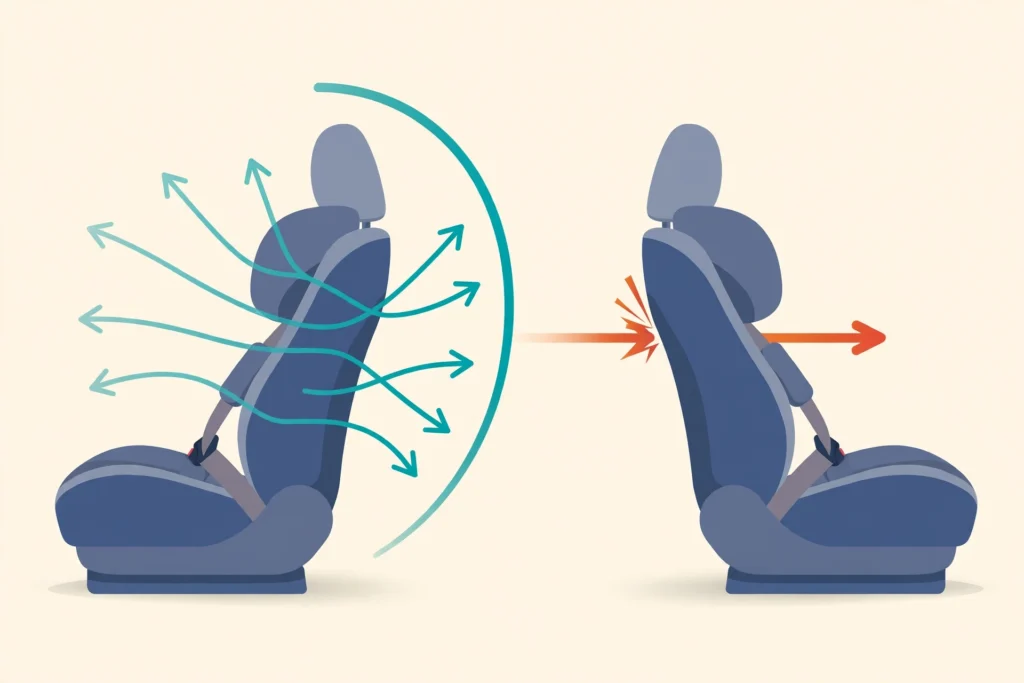
In a frontal crash — the most common type of serious collision — a rear-facing seat cradles the child’s entire body. The force of impact spreads across the back of the seat, protecting the head, neck, and spine.
A young child’s head is disproportionately large and heavy relative to their body, and their neck vertebrae and ligaments are still developing. In a forward-facing seat during a frontal crash, the head snaps forward violently, placing enormous stress on the underdeveloped neck and spinal cord. Rear-facing eliminates this risk almost entirely.
Research published in peer-reviewed journals has consistently found that rear-facing children under age 2 are significantly less likely to suffer serious injury compared to forward-facing children of the same age.
What the Law Requires (State by State)
As of 2026, a growing number of states legally mandate rear-facing until age 2, including California, New Jersey, Pennsylvania, and others. Some states set the requirement by age, others by age and weight.
Important: State minimums are floors, not ceilings. Even if your state only requires rear-facing until age 1, following the AAP guidance (age 2 minimum, longer if possible) is the safer choice.
Use our free car seat law checker to see the exact requirement for your state, or browse all state laws.
Signs Your Child Has Outgrown Rear-Facing
Your child is ready to switch when one of these is true:
- They reach the rear-facing weight limit of their convertible seat (typically 40–50 lbs depending on the model)
- They reach the rear-facing height limit — usually when the top of their head is within 1 inch of the top of the seat shell
- They are well past age 2 AND have outgrown the seat limits above
Not a sign: Their legs look cramped or touch the back seat. Children are flexible, and bent legs are not a safety concern. Broken legs heal; spinal cord injuries don’t.
Common Myths About Rear-Facing
“My child’s legs are too long — they must be uncomfortable”
Children naturally sit with crossed or bent legs. There is no evidence that rear-facing causes leg injuries or discomfort. In actual crash data, forward-facing children suffer more leg injuries than rear-facing children.
“My 18-month-old hates rear-facing and cries”
Discomfort is worth investigating (straps too tight? seat angle wrong? too hot?), but the direction of the seat is rarely the actual cause. Try adjusting the recline angle, checking strap snugness, or adding a car-safe mirror so they can see you.
“My state only requires it until age 1, so age 1 is fine”
Legal minimums lag behind safety science. The law sets the floor of what’s allowed, not the ceiling of what’s safe. The AAP guidance exists because the data supports it.
Choosing a Seat That Lasts Rear-Facing Longer
If you want to maximize rear-facing time:
– Look for high rear-facing weight limits (40–50 lbs). Seats with 50-lb rear-facing limits can often accommodate children until age 4.
– Check the shell height. Taller shells mean more growing room before the 1-inch rule kicks in.
– Consider an extended rear-facing convertible seat designed specifically for longer use.
Frequently Asked Questions
Is it legal to keep my child rear-facing past age 2?
Yes, absolutely. No state prohibits extended rear-facing. The law sets minimums; going beyond them is always allowed.
What if my child is over the weight limit but under age 2?
Follow the seat’s limits. If your child exceeds the rear-facing weight or height limit before age 2, switch to forward-facing with a harness. The seat limits are hard safety boundaries.
Can I turn my child forward-facing for a long road trip and back after?
No. Every ride should be rear-facing until they’re ready to switch permanently. There’s no safe exception for convenience.
Does rear-facing apply to the center seat or side seats?
Rear-facing applies regardless of seating position. The center rear seat is statistically the safest spot in the vehicle if you can get a proper installation there.