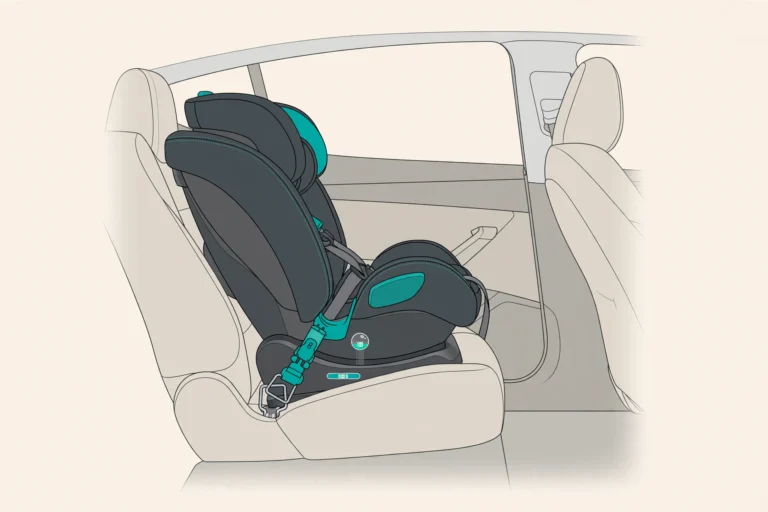
 BuckleUpLaws
Is It Illegal to Keep a Child Rear-Facing Past Age 2?
Many parents hear that children should turn forward-facing when they reach their second birthday. Others worry that keeping a toddler rear-facing for longer could break the law.
So, is it illegal to keep a child rear-facing past age 2?
No, keeping a child rear-facing past age 2 is not inherently illegal in the United States. In general, children can continue riding rear-facing as long as they remain within the car seat manufacturer's permitted height and weight limits and the seat is used correctly.
However, child passenger safety laws vary by state, so parents should check the requirements where they live.
Safety experts also recommend keeping children rear-facing for as long as possible, rather than switching simply because a child turns 2.
In this guide, we’ll explain the difference between state law and safety recommendations, how to check your state's rules, and when a child should move to a forward-facing car seat.
Is It Illegal to Keep a Child Rear-Facing Past Age 2?
In general, no. There is no nationwide law requiring parents to turn a child forward-facing immediately after the second birthday.
Instead, individual states establish their own child restraint requirements. Some states require children to remain rear-facing until a specified age, often with an exception when the child exceeds the car seat manufacturer's height or weight limits. Other states have different requirements.
A state law that requires rear-facing travel until age 2 generally establishes a minimum requirement, not a rule that children must turn forward-facing on their second birthday.
For example, if your state requires a child to remain rear-facing until age 2, continuing to use a suitable rear-facing seat after that age is not automatically prohibited by that requirement.
The important points are:
Age 2 is not a nationwide deadline for switching to a forward-facing seat.
State laws differ, so you should check the current requirements for your location.
Manufacturer limits matter. Your child must remain within the seat's rear-facing height, weight, and other specified fit requirements.
Safety recommendations may go beyond the law. A child may be legally permitted to turn forward-facing before it is the safest choice.
You can check the rules that apply to your family in ourrear-facing car seat laws by state guide.
Why Do Parents Think Rear-Facing Past Age 2 Is Illegal?
The confusion often comes from the way child passenger safety laws and recommendations are discussed.
State Laws Set Different Requirements
Some states specify a minimum age for rear-facing travel, while others use different child restraint requirements. These differences can make it difficult for parents to know whether a rule applies nationwide or only in their state.
A law requiring rear-facing travel until age 2 does not automatically mean children must turn forward-facing at age 2.
Age-Based Safety Advice Can Be Misunderstood
Parents may see age 2 mentioned in a car seat guide and assume it is the exact age when rear-facing must end.
However, the American Academy of Pediatrics (AAP) recommends keeping children rear-facing until they reach the highest weight or height allowed by their car seat manufacturer. Many convertible car seats accommodate rear-facing use well beyond age 2.
Some Children Outgrow Infant Seats Before Age 2
An infant-only car seat may have lower height or weight limits than a convertible seat. When a child outgrows an infant seat, parents can often move the child to a convertible or all-in-one seat that continues to be used rear-facing.
Outgrowing one particular seat does not necessarily mean a child has outgrown rear-facing travel altogether.
Learn more about: The 4’9″ Rule for Booster Seats: Why Does Height Matter?
Why Is Keeping a Child Rear-Facing Longer Safer?
Rear-facing car seats are designed to support a young child's head, neck, and spine during a crash.
Young children have different body proportions from adults. Their heads are relatively large compared with their bodies, and their developing necks and spines need additional protection.
In a frontal crash, a rear-facing restraint supports the child's head and body as the seat absorbs and distributes crash forces.
A forward-facing child may experience greater forces on the head and neck because the body moves forward while the head continues moving. Rear-facing travel helps reduce that stress.
This is why the National Highway Traffic Safety Administration (NHTSA) recommends keeping children rear-facing as long as possible, until they reach the top height or weight limit permitted by the car seat manufacturer.
For more information, see theNHTSA car seat and booster seat safety guide.
Can a 3-Year-Old Still Ride Rear-Facing?
Yes. A 3-year-old can continue riding rear-facing if the child fits within the manufacturer's rear-facing height and weight limits and meets any other requirements specified for that seat.
Age alone does not determine whether a child has outgrown rear-facing travel.
Many convertible and all-in-one car seats have rear-facing limits that allow children to remain in this position beyond their third birthday.
Before deciding whether to change the seat's direction, check:
The maximum rear-facing weight listed on the seat.
The maximum rear-facing height and any head-clearance requirements.
The manufacturer's instructions for proper harness fit and positioning.
Your state's current child restraint law.
If your 3-year-old still fits correctly in the rear-facing position, there is generally no safety reason to turn the seat forward-facing just because of age.
Also read: Why Can’t Kids Sit in the Front Seat?
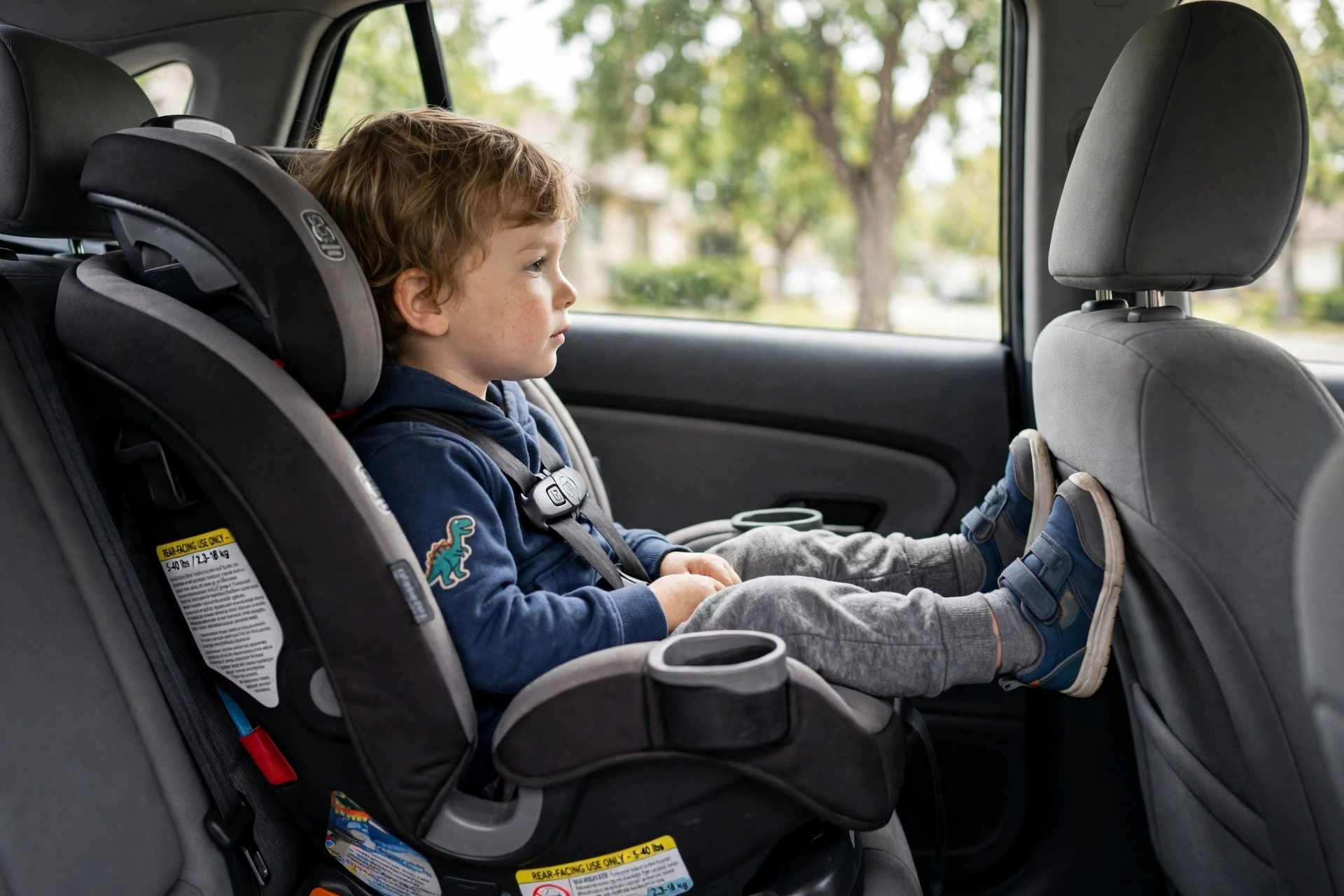
What If My Child's Legs Are Bent or Touch the Vehicle Seat?
Bent legs are a common reason parents consider switching their child forward-facing, but this alone is generally not a reason to make the change.
Toddlers are flexible and may bend their knees, cross their legs, or rest their feet against the vehicle seat in front of them.
The American Academy of Pediatrics explains that parents generally do not need to worry when a rear-facing child's feet touch the vehicle seat. Leg injuries are uncommon among children riding rear-facing.
What matters more is whether the child remains within the seat's limits and can be properly secured.
Do not modify the seat or add unapproved padding to create extra legroom. Always follow the car seat and vehicle manuals, including any restrictions on contact between the child restraint and the vehicle seat in front.
If your child appears uncomfortable or you are unsure about the fit, consult the seat manufacturer's instructions or a certified Child Passenger Safety Technician.
When Should You Turn a Child Forward-Facing?
You should generally wait until your child reaches the maximum rear-facing height or weight limit specified by the car seat manufacturer.
Once your child outgrows the rear-facing position, the next stage is typically a forward-facing car seat with a harness and top tether, used according to the manufacturer's instructions.
Follow these steps before switching:
1. Check the car seat label. Find the maximum rear-facing weight and height limits for your particular model.
2. Read the instruction manual. Some seats have additional fit requirements, including limits on head position or clearance.
3. Confirm your state law. Your state may specify a minimum rear-facing age or other requirements that apply to your child.
4. Check the next seat's instructions. When your child is ready to move forward-facing, install the seat correctly and use the harness and tether as directed.
Do not rely on age alone, and do not switch simply because your child wants to face forward or looks too big for an infant carrier.
TheNHTSA guide to installing rear-facing car seats explains how to check fit and install the seat correctly.
Do Rear-Facing Car Seat Laws Differ by State?
Yes. Child passenger safety laws vary across the United States, and the minimum legal requirements are not identical in every state.
Some states explicitly require children to remain rear-facing until at least age 2. Others use different rules, exceptions, or child restraint requirements.
For example, Pennsylvania requires children younger than 2 to ride in a rear-facing child restraint until they outgrow the manufacturer's maximum height or weight recommendations. Other states may use different statutory wording.
These differences matter if you move to another state or travel with your child. Do not assume that the law where you previously lived is the same as the law at your destination.
When checking a state's requirements, look for:
The minimum age for rear-facing travel, if specified.
Any height or weight exceptions.
The child restraint requirements that apply after rear-facing use.
The official effective date and current statutory wording.
Our rear-facing car seat laws by state resource is the most relevant place to start. Always verify important legal questions with the applicable state's official transportation or legislative website.
Common Myths About Extended Rear-Facing
Myth 1: A child must turn forward-facing at age 2.
Fact: There is no nationwide rule requiring every child to turn forward-facing at age 2. State requirements vary, and safety experts recommend rear-facing for as long as the child fits within the manufacturer's limits.
Myth 2: Keeping a child rear-facing longer is illegal.
Fact: Keeping a child rear-facing beyond age 2 is generally permitted when the seat is appropriate and used correctly. Check your state's requirements for any specific conditions.
Myth 3: Bent legs mean the child has outgrown the seat.
Fact: Bent knees or feet touching the vehicle seat do not automatically mean the child has outgrown the rear-facing position.
Myth 4: A child should switch as soon as they turn 2.
Fact: The child's size and the car seat's limits are more important than the birthday alone.
Myth 5: Every state has the same rear-facing law.
Fact: State laws differ. Check the law for the state where you live and any state in which you will be driving.
Frequently Asked Questions
Is it illegal to keep a child rear-facing after age 2?
Generally, no. There is no nationwide law requiring children to turn forward-facing at age 2. Check your state's specific requirements and the manufacturer's instructions for your car seat.
Can I keep my 4-year-old rear-facing?
Possibly, if the child remains within the seat's rear-facing height and weight limits and meets its fit requirements. Not every car seat accommodates a 4-year-old rear-facing, so check the specific model.
Do I have to turn my child forward-facing when they turn 2?
Not simply because they turn 2. Keep your child rear-facing as long as possible within the seat's limits, while complying with your state's law.
What if my state requires rear-facing until age 2?
A requirement to remain rear-facing until age 2 generally establishes a minimum legal period. It does not automatically require switching to forward-facing at that age. Check the exact statutory wording and any exceptions.
Where can I check rear-facing car seat laws for my state?
Start with your state's official transportation agency or legislative website. You can also use theBuckleUpLaws rear-facing car seat laws by state guide as a starting point.
Final Verdict: Can You Keep a Child Rear-Facing Past Age 2?
In most cases, keeping a child rear-facing beyond age 2 is not illegal simply because of the child's age. The specific legal requirements depend on the state, and parents should check the current rules that apply to their location.
From a safety perspective, the recommendation is straightforward: keep your child rear-facing for as long as possible, until the child reaches the car seat manufacturer's rear-facing height or weight limit or another specified fit requirement.
Do not rush to turn a toddler forward-facing just because of a birthday, bent legs, or pressure from others. Use the right seat, install it correctly, and follow both the manufacturer's instructions and your state's law.
For more guidance, exploreBuckle Up Laws.