 BuckleUpLaws
FAA Approved Car Seat: How to Find the Airplane Sticker
Planning to fly with your baby or young child? Before packing your car seat, there is one important detail you should check: whether it is approved for use on an airplane.
A car seat that meets regular vehicle safety standards is not automatically approved for aircraft use. Airlines and aviation regulations have specific requirements for child restraint systems, and checking the certification label can help you avoid problems at the airport.
So, how can you tell if a car seat is FAA-approved?
Look for the aircraft certification statement on your car seat that reads: “This Restraint is Certified for Use in Motor Vehicles and Aircraft.” For car seats certified under U.S. standards, this statement appears in red lettering. Other qualifying child restraints may carry approved foreign-government, United Nations, or FAA-specific markings.
In this guide, we’ll explain where to find the FAA-approved car seat sticker, what the label means, how to check your seat’s certification, and what to do if you cannot find it before your flight. Let’s go!!
What Does an FAA-Approved Car Seat Label Look Like?
An FAA-approved car seat label is a certification marking that indicates the child restraint meets the applicable requirements for aircraft use.
For car seats manufactured under U.S. motor vehicle safety standards, the familiar certification label includes two statements:
“This child restraint system conforms to all applicable Federal Motor Vehicle Safety Standards.”
“This Restraint is Certified for Use in Motor Vehicles and Aircraft.”
The second statement appears in red lettering.
This is the important wording parents should look for when checking a U.S.-certified car seat for airplane travel.
The label may be located on the side, back, or bottom of the car seat, depending on the manufacturer and model.
Keep in mind that the absence of this particular U.S. label does not automatically mean a restraint is not approved. Some child restraints qualify through other FAA-recognized routes.
The FAA explains these requirements in its official Child Restraint Systems guidance.
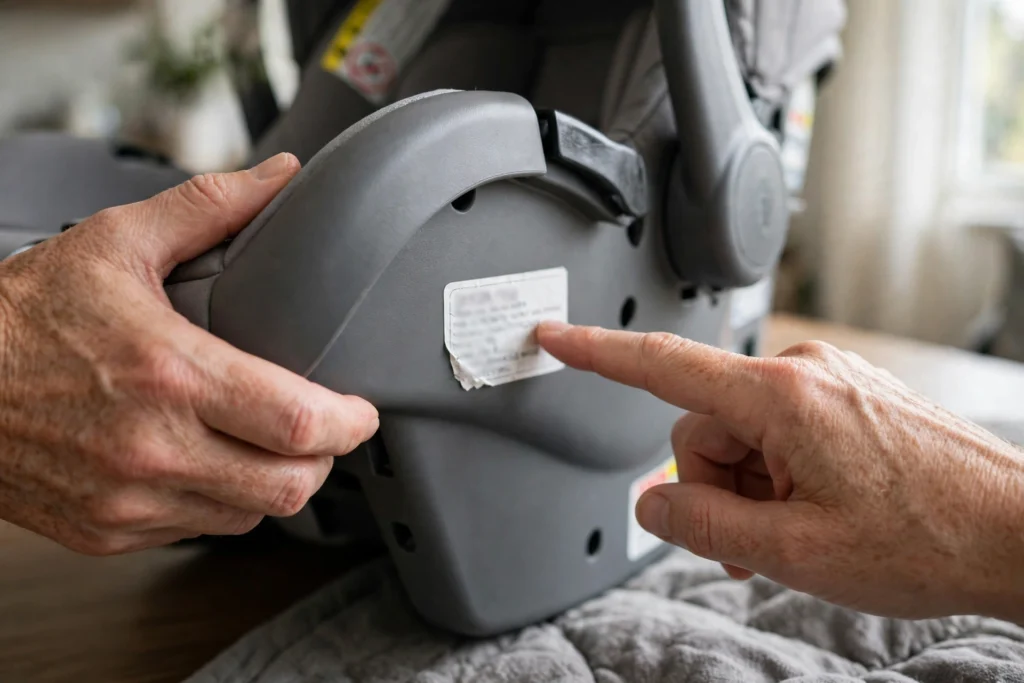
Where Can You Find the FAA Sticker on a Car Seat?
The aircraft certification label is usually attached to the car seat itself.
However, its exact location depends on the design and manufacturer.
Here are some places to check:
1. Check the Side of the Car Seat
Start by examining both sides of the car seat.
Some manufacturers place the certification label on the side of the plastic shell, near the harness adjustment area or installation instructions.
Look for a white, silver, or other manufacturer-provided information label containing the aircraft certification wording.
2. Check the Back of the Seat
If you cannot find the sticker on the sides, turn the car seat around and examine the back.
Some models have their safety and certification information attached to the rear of the shell.
You may need to move removable fabric covers carefully to locate the label, but do not remove any permanently attached certification information.
Read more about: Car Seat Moves More Than 1 Inch? How to Fix It
3. Check the Bottom of the Car Seat
Another possible location is underneath the seat.
Some manufacturers position product identification and regulatory labels near the bottom, close to the base.
Check carefully without damaging or removing the manufacturer’s labels.
4. Check the Manufacturer’s Instruction Manual
If the sticker is difficult to locate, consult your car seat instruction manual.
The manual can help you identify the aircraft-use statement, understand the approved installation method, and confirm whether your seat is certified for aircraft use.
You can also contact the manufacturer’s customer support team and provide your model number.
Important: Do not rely on a similar-looking sticker from another model or assume that all seats from the same manufacturer have the same certification.
What Does the Red Lettering on a Car Seat Sticker Mean?
The red lettering is an important part of the aircraft certification label used on qualifying U.S.-certified child restraints.
The statement reads:
“This Restraint is Certified for Use in Motor Vehicles and Aircraft.”
It tells parents and airline personnel that the restraint has the required certification for use in both environments.
However, the wording is more important than the color alone.
A red label containing a different statement does not automatically prove aircraft approval.
Similarly, a seat without this exact red-letter statement may still qualify under another recognized approval route, such as certain foreign-government or United Nations standards.
If you are uncertain, consult the FAA guidance and your car seat manufacturer rather than making a decision based on color alone.
Learn more about: When to Stop Using LATCH: Understanding the 65-Pound Rule
Does Every Car Seat Have an FAA Approval Sticker?
No. Not every car seat has the same aircraft certification label.
Many U.S.-certified car seats approved for aircraft use carry the familiar red-letter statement.
However, qualifying restraints manufactured under foreign standards may use different approval markings.
The FAA recognizes several routes for qualifying child restraint systems.
These include:
- U.S. certification for use in motor vehicles and aircraft.
- Certain foreign-government approval markings.
- Qualifying United Nations child restraint approval markings.
- Specific FAA approvals, including applicable Type Certificate, Supplemental Type Certificate, or Technical Standard Order approvals.
For example, some United Nations-approved restraints carry a circular marking with the letter “E” and a country identification number.
The applicable approval marking must meet the relevant aviation requirements. A generic safety certification or an ordinary E-mark should not automatically be treated as proof of aircraft approval.
For more details, consult the FAA’s Advisory Circular AC 120-87C.
How to Check If Your Car Seat Is FAA-Approved Before Flying
Finding the label is the first step, but a complete check helps you confirm the information before your travel date.
Follow these steps before your travel date.
Step 1: Identify Your Car Seat Model
Find the manufacturer name, model name, model number, and manufacturing date.
These details are usually printed on a product information label on the car seat.
Having the exact model information makes it easier to confirm aircraft certification with the manufacturer.
Step 2: Locate the Aircraft Certification Label
Check the sides, back, and bottom of the car seat for the aircraft certification statement.
For U.S.-certified restraints, look for the red-letter statement confirming that the restraint is certified for use in motor vehicles and aircraft.
If your seat uses a different recognized approval route, such as a foreign-government or United Nations standard, confirm that the marking applies to aircraft use.
Step 3: Read the Instruction Manual
The certification label is important, but the instruction manual provides more detail.
Look for the section about aircraft installation.
Check:
- Whether the seat is approved for aircraft use.
- Which installation direction is permitted.
- How the airplane seat belt should be routed.
- Whether there are aircraft-specific restrictions.
- Your child’s permitted height and weight limits.
Step 4: Confirm Your Child Fits the Seat
An aircraft-approved car seat is only the correct choice if it is suitable for your child.
Check the maximum weight, height, and harness requirements.
For younger babies, a properly approved rear-facing infant seat may be suitable if your child meets the applicable size and fit requirements.
Step 5: Contact Your Airline
Before departure, contact the airline and confirm that your particular restraint is accepted.
Ask about:
- Seat width and aircraft compatibility.
- Permitted seating positions.
- Installation requirements.
- Whether a separate ticket is required.
- Any additional documentation or procedures.
An approved car seat still needs to fit the aircraft seating arrangement and be installed according to the manufacturer’s instructions.
Can You Use a Car Seat on an Airplane Without the FAA Sticker?
This depends on the type of approval your car seat has.
If a U.S.-manufactured restraint should carry the aircraft certification statement but you cannot find it, do not assume the seat is approved.
First, check the manual and contact the manufacturer.
However, some foreign-made child restraints may use different qualifying approval labels, so the absence of the familiar U.S. red-letter sticker is not always conclusive.
The FAA also recognizes certain foreign-government and United Nations approval markings.
If you cannot establish that your restraint qualifies under an applicable approval route, do not assume the airline will accept it.
Ask the manufacturer and airline for clarification before traveling.
This can help prevent unexpected problems during boarding.
Also read more about: Do Babies Need Car Seats on Airplanes? What Parents Should Know
Are Booster Seats FAA-Approved for Airplanes?
Ordinary belt-positioning booster seats are generally not approved for use during aircraft ground movement, takeoff, and landing.
The reason is that boosters are designed to position a vehicle’s lap-and-shoulder seat belt correctly across a child’s body.
Airplane seats use a different restraint system, so a regular booster does not perform the same function.
The FAA also identifies baby carriers and backless child restraints as unsuitable for use during these critical phases of flight.
For an older child who needs additional restraint, check whether an approved aircraft child restraint is appropriate.
Another option for certain children is the FAA-approved CARES child aviation restraint system, which has specific size and use requirements.
What If Your Car Seat Is Not Approved for Airplane Use?
If your car seat does not meet aircraft-use requirements, you should not attempt to use it as an onboard child restraint.
You may still have options for transporting it.
Check It With Your Airline
Many airlines allow passengers to check car seats as baggage or at the boarding gate.
However, baggage rules and procedures vary.
Ask the airline whether it offers complimentary car seat checking and whether protective packaging is recommended.
Consider an Aircraft-Approved Alternative
If you frequently travel with your child, you may consider a suitable child restraint that has the required aircraft certification.
Before purchasing anything, verify that it fits your child’s size and is approved for your intended use.
Plan for Transportation at Your Destination
Remember that your child will still need an appropriate restraint when traveling by car after landing.
If you are checking your regular car seat, make sure you have a safe transportation arrangement at your destination.
Common Mistakes Parents Make When Checking an FAA Car Seat Sticker
Even careful parents can misunderstand aircraft certification labels.
Here are some common mistakes to avoid.
Assuming every vehicle car seat is airplane-approved: A car seat meeting vehicle safety standards does not automatically qualify for aircraft use.
Checking only the product packaging: Approval should be verified on the restraint itself or through its recognized approval markings.
Confusing the expiration label with aircraft certification: A manufacturing date or expiration date does not establish airplane approval.
Assuming every red sticker means FAA approval: Read the actual certification statement instead of judging by color.
Ignoring the instruction manual: The manual contains important information about aircraft installation and the child’s permitted size.
Waiting until boarding to check: Discovering a certification problem at the airport can create unnecessary stress and delays.
Checking everything before departure is much easier.
Frequently Asked Questions
How do I know if my car seat is FAA-approved?
Look for the aircraft certification statement on the car seat. For U.S.-certified restraints, the red-letter wording is “This Restraint is Certified for Use in Motor Vehicles and Aircraft.” Certain qualifying foreign-government, United Nations, and FAA-specific approval markings may also be accepted.
What does the FAA-approved car seat sticker say?
The familiar U.S. certification label includes the statement “This Restraint is Certified for Use in Motor Vehicles and Aircraft.” It appears in red lettering alongside the applicable federal motor vehicle safety standards statement.
Where is the FAA sticker located on an infant car seat?
It may be attached to the side, back, or bottom of the infant car seat. Check the product labels and instruction manual for your particular model.
Can I use a car seat on a plane if the sticker is missing?
Do not assume it is approved. Check the manual, contact the manufacturer, and verify whether another recognized approval marking applies. Confirm acceptance with your airline before traveling.
Are all Graco, Chicco, and Britax car seats FAA-approved?
You should not assume that every model from a particular manufacturer is approved. Aircraft-use certification can differ between individual models. Check the exact seat’s label and manual.
Does an FAA-approved car seat need to be installed in a window seat?
Generally, airlines require child restraints to be positioned so they do not block access to the aisle or an emergency exit. Window seats are commonly used, but seating requirements can vary by aircraft and airline. Confirm your assigned seat before departure.
Can I use LATCH to install my car seat on an airplane?
No. Airplane passenger seats generally do not provide the vehicle-style lower anchors used by LATCH systems. Follow the car seat manufacturer’s aircraft installation instructions, which generally use the airplane seat belt.
Final Verdict: Check the FAA Car Seat Sticker Before Your Flight
Knowing how to identify an FAA-approved car seat can make traveling with your baby or young child much easier.
Start by checking the sides, back, and bottom of your car seat for the aircraft certification label. If it is certified under U.S. standards, look for the red-letter statement confirming that it is certified for use in motor vehicles and aircraft.
Remember that certain foreign-government, United Nations, and FAA-specific approval markings may also qualify.
Once you identify the correct approval, check the manufacturer’s instructions, confirm your child fits the restraint, and contact your airline about seating and installation requirements.
A few minutes of preparation can help prevent last-minute surprises and make your family’s flight more comfortable.
At Buckle Up Laws, our goal is to make child passenger safety information easier for parents to understand, whether they are traveling by car or airplane.
Disclaimer: This article provides general educational information about U.S. aircraft child restraint requirements. It is not a substitute for current FAA regulations, airline policies, or the instructions provided by your car seat manufacturer. Approval requirements and acceptable markings can vary depending on the restraint’s certification standard. Always verify your specific car seat before flying.