 BuckleUpLaws
Do Babies Need Car Seats on Airplanes? What Parents Should Know
Planning your first flight with a baby can bring up plenty of questions. You may already know that your child needs a properly installed car seat when traveling by car, but does the same rule apply when flying?
Do babies need car seats on airplanes, or can they travel safely in a parent’s lap?
The answer depends on your child’s age, the airline’s policies, and the type of restraint you plan to use.
In the United States, babies under two years old can generally travel as lap infants without purchasing their own seat. However, the Federal Aviation Administration (FAA) strongly recommends securing babies in an approved child restraint system (CRS) in their own airplane seat.
A car seat used on an airplane must meet the applicable aircraft-use requirements. Not every car seat approved for use in a vehicle is automatically approved for an aircraft.
In this guide, we’ll explain airplane car seat rules, FAA recommendations, lap infant travel, and how to prepare your baby’s car seat before boarding. Let’s stay with us!
Do Babies Need Car Seats on Airplanes?
No, U.S. federal regulations generally do not require babies under two years old to have their own car seat or airplane seat. They may travel on an accompanying adult’s lap, subject to airline policies.
However, the FAA strongly encourages parents to purchase a separate seat and use an approved child restraint system.
Why?
An airplane can experience unexpected turbulence, even when the flight initially feels smooth. During sudden movement, an adult may struggle to hold a baby securely.
A properly approved child restraint provides a more secure option because the baby is buckled into a separate seat rather than depending on an adult’s arms.
The FAA recommends keeping children secured in an approved restraint for the duration of the flight.
You can read the official guidance on the FAA’s Flying With Children page.
Can Babies Fly on a Parent’s Lap?
Yes. In the United States, children who have not reached their second birthday can generally travel as lap infants on commercial flights.
This means you may not need to purchase a separate seat for your baby.
However, there are important considerations.
What Is a Lap Infant?
A lap infant is a baby who travels without occupying a separately ticketed airplane seat.
Instead, the child sits on the accompanying adult’s lap during the flight.
Airlines commonly allow this arrangement for children under two, although international routes may involve additional taxes, documentation, or other conditions.
Is It Safe for a Baby to Fly on Your Lap?
Although lap infant travel is generally permitted, it is not the safest option during unexpected turbulence.
An adult may have difficulty holding a baby securely when an airplane experiences sudden movement.
This is why the FAA recommends using an approved child restraint in a separate seat.
The American Academy of Pediatrics (AAP) also advises parents that an approved child safety restraint is the safer choice for babies traveling by air.
For additional guidance, see the AAP’s Flying With Baby recommendations.
What Type of Car Seat Can You Use on an Airplane?
Not every car seat can be used during a flight.
If you plan to bring your baby’s car seat into the airplane cabin, check whether it is approved for aircraft use.
In the United States, an appropriate child restraint should have the required aircraft certification label.
Look for wording such as:
“This restraint is certified for use in motor vehicles and aircraft.”
The label is generally found on the car seat itself.
Before traveling, check the following:
- The car seat has the required aircraft-use approval or certification marking.
- Your baby meets the manufacturer’s height and weight requirements.
- The seat can be installed using the airplane’s passenger seat belt.
- The car seat fits the airline’s seating requirements.
- The airline permits the particular restraint and installation arrangement.
Do not assume that a car seat is airplane-approved simply because it meets ordinary vehicle safety standards.
Also read more about: Is It Illegal to Keep a Child Rear-Facing Past Age 2?
Can You Use a Rear-Facing Infant Car Seat on an Airplane?
Yes, an aircraft-approved rear-facing infant car seat can generally be used if your baby meets its size requirements and the airline’s seating conditions.
Many parents prefer bringing an infant carrier because their babies are already familiar with it.
When installing it, follow the manufacturer’s aircraft instructions rather than automatically copying the vehicle installation procedure.
Some car seats have different installation instructions for aircraft because airplane seats use different belt systems.
Also check the recline and positioning requirements in the manual.
Can You Use a Convertible Car Seat on an Airplane?
Yes, an aircraft-approved convertible car seat can generally be used if it meets the applicable aircraft certification standards and fits the assigned airplane seat.
Convertible car seats are usually heavier and larger than infant carriers, so check the seat dimensions carefully.
Some convertible car seats may fit more easily in certain airplane seat positions than others, depending on the seat design and aircraft layout.
Also read more about: rear-facing car seat laws by state
How to Use a Car Seat on an Airplane
Once you have confirmed that your car seat is suitable for aircraft use, preparing before boarding can make the process easier.
Step 1: Check the Aircraft Approval Label
Look for the aircraft-use certification statement on the car seat.
If you cannot find it, consult the instruction manual or contact the manufacturer.
Do not rely on a retailer’s description or assume that every model from the same brand has identical approval.
Step 2: Purchase a Separate Seat for Your Baby
If you want your baby secured in an approved car seat during the flight, you generally need to purchase a separate passenger seat.
A lap infant cannot simply be placed in a car seat occupying another passenger’s seat without the appropriate ticket and airline authorization.
Confirm the booking arrangements directly with your airline.
Step 3: Check the Airline’s Car Seat Policy
Contact the airline before your travel date.
Ask whether your particular car seat is accepted, whether there are seat-width restrictions, and which seating positions are permitted.
Many airlines require an approved child restraint to be installed in a window seat so it does not obstruct access to the aisle or an emergency exit.
Policies and aircraft configurations can vary.
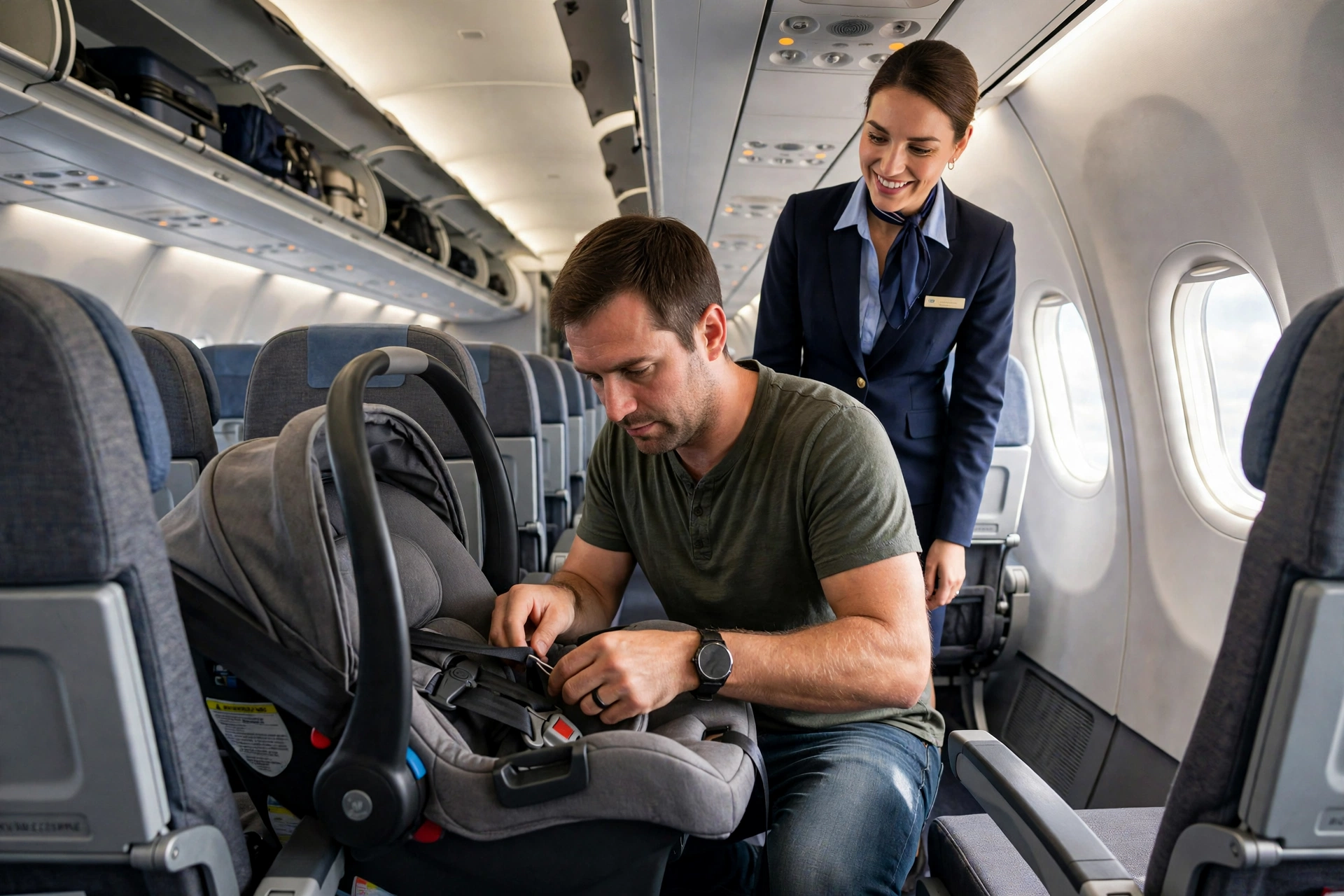
Step 4: Install the Car Seat According to Its Manual
Use the airplane’s passenger seat belt and follow the car seat manufacturer’s aircraft installation instructions.
Do not assume that the LATCH system or vehicle lower anchors are available on an airplane seat.
The installation method may differ from the one you use in your car.
Step 5: Secure Your Baby Properly
Place your baby in the restraint and fasten the harness according to the manufacturer’s instructions.
Check that the straps are flat, correctly positioned, and snug.
Avoid bulky coats or padding underneath the harness.
Make sure your baby’s head and body are positioned correctly according to the seat’s instructions.
Learn more about: Toddler’s Legs Bent in a Rear-Facing Car Seat: Is It Safe?
Step 6: Follow the Cabin Crew’s Instructions
Flight attendants may need to verify the seat’s placement and installation.
Listen to their instructions and make any required adjustments before departure.
Your child should remain properly secured whenever the restraint is required and appropriate, including during taxi, takeoff, landing, and turbulence.
What Is the FAA-Approved CARES Harness?
The CARES harness is a belt-and-buckle device designed to secure a child in an aircraft seat.
It is the only harness approved by the FAA as an alternative to a car seat for use on an aircraft.
It loops around the airplane seat back and uses the aircraft passenger seat belt to secure the child.
The CARES harness is designed for children who:
- weigh between 22 and 44 pounds
- are at least 1 year old
- reach 40 inches or shorter in height
- can sit in their own seat
Install the CARES harness only as the manufacturer instructs, and only in a seat that the airline permits.
You can find additional information through the FAA’s child restraint guidance.
Can You Use a Booster Seat on an Airplane?
A regular booster seat is not an appropriate substitute for an approved aircraft child restraint.
Booster seats are designed to position a vehicle’s lap-and-shoulder belt correctly across a child’s body.
Airplane passenger seats use different restraint systems, so ordinary booster seats are generally not approved for use during aircraft operations.
If your child needs an approved restraint, check the aircraft certification and manufacturer instructions rather than assuming a booster seat will work.
What If You Do Not Want to Bring a Car Seat on the Plane?
You are not required to bring a car seat on a plane. However, having a separate seat with an approved car seat or child restraint can provide additional protection for your baby during the flight if the aircraft experiences turbulence.
Traveling With a Lap Infant
You may choose to travel with your baby on your lap if permitted by the airline.
However, remember that the FAA recommends an approved restraint in the baby’s own seat for better protection during turbulence.
Using an Airline Bassinet
Some airlines offer bassinets on selected aircraft and routes.
These are usually available for younger babies who meet the airline’s age, height, and weight restrictions.
A bassinet can be useful for resting during a flight, but it is not a substitute for an approved restraint during taxi, takeoff, landing, or turbulence.
Follow the airline’s instructions about when your baby must be removed from the bassinet and secured.
Checking Your Car Seat
If you do not plan to use your car seat in the airplane cabin, some airlines allow it to be checked at the ticket counter or gate.
However, baggage policies differ, and checked equipment may be exposed to handling damage.
Check the airline’s current policy before traveling.
If possible, use a protective travel bag and inspect the seat afterward. Follow the manufacturer’s advice if you suspect the seat has been damaged.
Also read more about: How to Install an Infant Car Seat Without the Base Safely
Tips for Flying With a Baby and Car Seat
A little preparation can make flying with an infant much easier.
Here are some practical tips:
- Check the aircraft certification: Confirm that your car seat is approved for use on an airplane.
- Contact the airline early: Ask about seating arrangements, seat dimensions, and child restraint requirements.
- Bring the instruction manual: Keep the car seat manual available in case you need to check installation instructions.
- Choose an appropriate seat: Confirm that your assigned seat can accommodate the restraint without blocking an exit or aisle.
- Avoid bulky clothing: Dress your baby in clothing that allows the harness to fit correctly.
- Pack feeding supplies: Feeding during ascent or descent may help some babies manage changes in cabin pressure.
- Allow extra boarding time: Installing a car seat takes additional time, so take advantage of any family boarding arrangements.
Remember that preparation is just as important as choosing the right restraint.
Frequently Asked Questions
Do babies need their own seats on airplanes?
In the United States, babies under two can generally travel as lap infants. However, the FAA recommends purchasing a separate seat and using an approved child restraint for better safety.
Is it illegal to fly with a baby on your lap?
No. U.S. federal regulations generally permit children under two to travel on an accompanying adult’s lap. Airline policies and international travel requirements may differ.
Can I bring my regular infant car seat on a plane?
Yes. If a car seat is certified for aircraft use, you can use it on a plane. Children under two who are traveling with their parents can use their own approved car seat on a plane, provided the seat fits the assigned seat and the airline’s requirements.
Do airlines provide car seats for babies?
Most airlines do not provide car seats for babies. If you want your baby secured in an approved car seat or child restraint, bring your own approved car seat or child restraint.
Can a baby sleep in a car seat during a flight?
A baby can usually sleep in an approved car seat during the flight, provided the harness is properly secured and the seat is installed according to the manufacturer’s instructions.
Can I use a car seat without its base on an airplane?
You can use an approved car seat on an airplane without its base if the seat supports it. However, this may require attaching the car seat with the airplane’s passenger seat belt instead of the base.
Does a baby need a car seat for an international flight?
Requirements differ between countries and airlines. Some countries have different rules for lap infants, approved restraints, and child seating. Check the airline’s policy and the applicable aviation authority’s requirements for every country on your itinerary.
Final Verdict: Should You Use a Car Seat for Your Baby on an Airplane?
Although babies under two years old can generally fly as lap infants on U.S. commercial flights, using an approved child restraint in a separate airplane seat is the safer choice recommended by the FAA.
If you plan to bring a car seat, confirm that it has the required aircraft-use certification, fits your baby, and is accepted by your airline.
Do not assume that every vehicle car seat or booster seat can be used on an airplane.
A little preparation can help make your journey safer and more comfortable for your family.
At Buckle Up Laws, we aim to help parents understand child passenger safety rules and make informed decisions about protecting their children both on the road and while traveling.