 BuckleUpLaws
What Age Can a Child Sit in the Front Seat in Texas?
If you’re a parent in Texas, you may be wondering when your child can legally move from the back seat to the front passenger seat. Perhaps your child is turning 12, has grown taller, or wants to sit beside you during family trips.
The answer isn’t as simple as reaching a certain birthday.
Texas law does not set a general minimum age for every child riding in the front passenger seat of an ordinary passenger vehicle. However, state child restraint laws still apply, and safety experts recommend that children younger than 13 ride in the back seat whenever possible.
Understanding the difference between legal requirements and safety recommendations can help you make the right decision for your family.
In this guide, we’ll explain Texas front-seat rules, child restraint requirements, airbag risks, and practical steps for keeping your child safe. Let’s go!!
What Age Can a Child Sit in the Front Seat in Texas?
Texas does not have a general statewide minimum age for front-seat passengers in ordinary passenger vehicles. The Texas Department of Public Safety explains that state law does not specify where a child must sit in the vehicle.
That does not mean the front seat is the safest option for every child. The National Highway Traffic Safety Administration (NHTSA) recommends that children younger than 13 ride in the back seat.
For parents, the practical distinction is:
- Legal requirement: Texas does not generally specify a minimum front-seat age for children in ordinary passenger vehicles.
- Safety recommendation: Keep children younger than 13 in the back seat whenever possible.
- Restraint requirement: Children must still use the appropriate child restraint or seat belt under Texas law and follow the restraint and vehicle manufacturers’ instructions.
Certain situations, including vehicles operated under specific childcare regulations, may be subject to additional rules. Do not assume that the general rule covers every type of vehicle or transport arrangement.
For the official explanation, review the Texas Department of Public Safety’s Occupant Safety Program FAQs.
What Does Texas Law Say About Child Car Seats and Boosters?
Although Texas does not set a general minimum front-seat age, it does have specific child passenger restraint requirements.
Under Texas Transportation Code Section 545.412, a child younger than 8 must be secured in an appropriate child passenger safety seat system unless the child is taller than 4 feet 9 inches. The restraint must be used according to the manufacturer’s instructions.
This requirement concerns the type of restraint a child must use; it should not be confused with a general rule about which row of seats the child may occupy.
Here is a simplified overview:
- Children younger than 8: An appropriate child safety seat or booster is generally required unless the child is taller than 4 feet 9 inches.
- Children 8 and older: The specific age-based requirement under Section 545.412 no longer applies, but correct seat belt use remains important.
- Children who are still too small for an adult seat belt: A suitable booster can improve belt fit, even when the child is no longer legally required to use one under the age-based rule.
Texas law also requires safety restraints to be used according to the manufacturer’s instructions. For the statutory language, consult the Texas Department of Public Safety’s occupant restraint laws.
Why Should Children Under 13 Generally Sit in the Back Seat?
Even when a child is legally allowed to sit in the front seat, the back seat is generally safer for children younger than 13.
The recommendation is based partly on the risks associated with front passenger airbags and the fact that children may not fit adult seating systems as well as adults do.
1. Front Airbags Can Cause Serious Injuries
Airbags deploy rapidly during certain crashes. They are designed to work with properly restrained occupants, but a child sitting too close to the dashboard may be exposed to significant force.
Younger passengers are particularly vulnerable if they lean forward, sit too close to the airbag, or are not restrained properly.
2. Children Have Different Body Proportions
A child may be tall enough to reach the dashboard or buckle a seat belt but still not fit the vehicle seat properly.
The lap belt may ride up onto the abdomen, while the shoulder belt may cross the neck or face. These problems can increase the risk of injury in a crash.
3. The Back Seat Provides More Distance From the Dashboard
The back seat places children farther from the front passenger airbag and dashboard. It is the recommended location for children who have not yet reached age 13.
For more detail, read our guide to why children should not sit in the front seat.
Can a 12-Year-Old Sit in the Front Seat in Texas?
Texas does not generally prohibit a 12-year-old from sitting in the front passenger seat of an ordinary passenger vehicle based on age alone.
However, that is different from saying it is the safest choice.
NHTSA recommends keeping children younger than 13 in the back seat. A 12-year-old may still have difficulty achieving a proper seat belt fit, depending on their height, body proportions, and the vehicle.
If your child is 12, consider waiting until at least age 13 before moving them to the front seat. If the child must sit in front because of a specific seating limitation, follow the vehicle manufacturer’s instructions and make sure the child is appropriately restrained.
Our broader article, Can a 12-Year-Old Sit in the Front Seat?, explains the age-specific safety considerations in more detail.
Does a Child Need to Be 4 Feet 9 Inches Tall to Sit in Front in Texas?
No. Texas does not use 4 feet 9 inches as a universal minimum height for front-seat passengers.
The 4-foot-9-inch measurement is primarily relevant to Texas’s child restraint law and to assessing whether an adult seat belt may fit a child properly.
For children younger than 8, Texas law generally requires an appropriate child passenger safety seat unless the child is taller than 4 feet 9 inches. But reaching that height does not automatically mean that the front seat is the safest place for the child.
Before allowing a child to use an adult seat belt without a booster, check that:
- The child’s back rests against the vehicle seatback.
- Their knees bend comfortably over the front edge of the seat.
- The lap belt rests low across the upper thighs and hips.
- The shoulder belt crosses the middle of the chest and shoulder.
- The child can maintain this position throughout the trip.
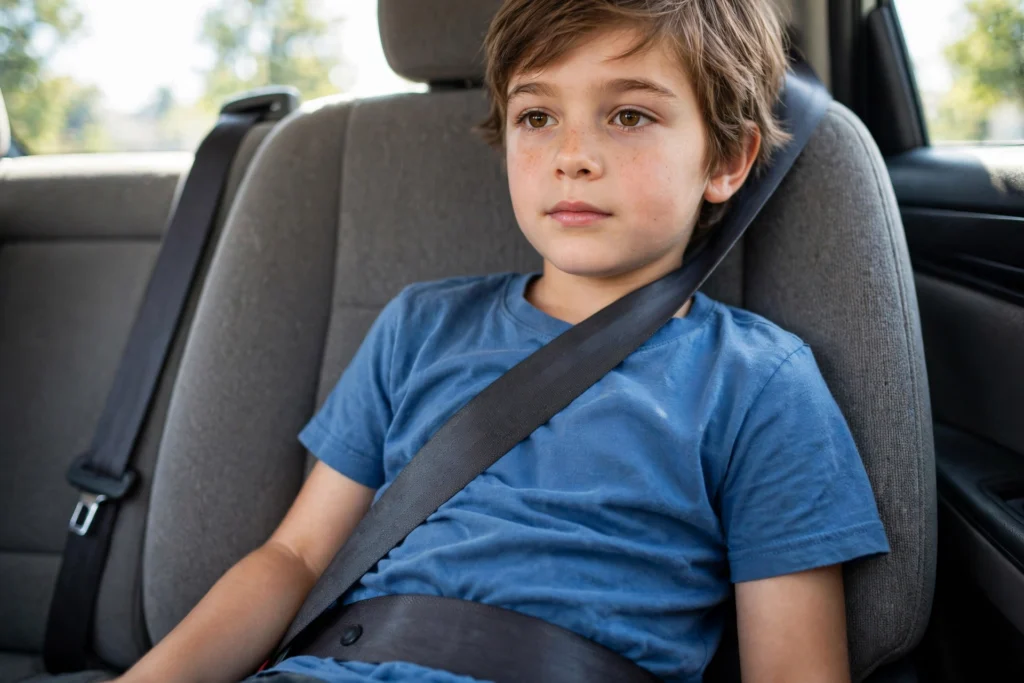
If the seat belt does not fit correctly, continue using an appropriate booster within its permitted limits.
You can also review our booster seat requirements by state guide.
What If Your Child Must Sit in the Front Seat?
Some vehicles do not have a rear seat, and certain family situations may limit available seating. If your child must ride in front, take extra care.
Check the vehicle owner’s manual. Follow its instructions about front passenger seating, airbags, and child restraints.
Move the seat back appropriately. Position the passenger seat as far from the dashboard as practical, following the manufacturer’s guidance.
Use the correct restraint. Make sure the seat belt fits properly or that a compatible booster is installed according to the relevant manuals.
Never put a rear-facing child seat in front of an active passenger airbag. This can cause catastrophic injuries.
Do not disable airbags yourself. Use an airbag deactivation feature only where the manufacturer expressly permits it and all applicable requirements are met.
These steps do not make the front seat preferable to the back seat for a child younger than 13. They are precautions for situations where a suitable rear seating position is unavailable.
Learn more about: High-Back vs. Backless Booster Seat: Which Is Better?
VERY Common Mistakes Texas Parents Should Avoid
Assuming Texas has a universal front-seat age of 13. Age 13 is a safety recommendation, not a general statewide minimum age written into Texas traffic law.
Assuming no minimum age means no safety restrictions. Child restraint requirements and manufacturer instructions still apply.
Treating 4 feet 9 inches as an automatic front-seat cutoff. This height is relevant to child restraint requirements and belt fit, not a universal front-seat rule.
Ignoring the airbag. A properly restrained child can still be at risk if positioned too close to an active passenger airbag.
Using the same rules for every vehicle. Vehicle design, seating arrangements, and restraint instructions differ.
Frequently Asked Questions
Is there a legal age for a child to sit in the front seat in Texas?
Texas does not generally set a minimum front-seat age for children in ordinary passenger vehicles. Other requirements and special circumstances may apply.
Can a 10-year-old sit in the front seat in Texas?
Texas does not generally prohibit front-seat seating for a 10-year-old based on age alone in an ordinary passenger vehicle. However, safety experts recommend keeping children younger than 13 in the back seat. Read more about: Does My 10-Year-Old Still Need a Booster Seat?
Can a 12-year-old sit in the front seat in Texas?
Generally, Texas law does not set a minimum front-seat age for ordinary passenger vehicles. Nevertheless, keeping a 12-year-old in the back seat until at least age 13 is the safer recommendation.
Does Texas law require a booster seat until age 8?
Texas generally requires a child younger than 8 to use an appropriate child passenger safety seat system unless the child is taller than 4 feet 9 inches. A booster may still be safer after the legal age threshold if the adult seat belt does not fit properly.
Is it safer for children to sit in the back seat?
Yes. NHTSA recommends that children younger than 13 ride in the back seat whenever possible because it reduces their exposure to front passenger airbags and other front-seat risks.
Final Verdict: When Can a Child Sit in the Front Seat in Texas?
Texas does not generally specify a minimum age for children to sit in the front passenger seat of an ordinary passenger vehicle. However, the absence of a general age restriction does not mean every child is ready to sit in front.
Keep children younger than 13 in the back seat whenever possible, follow Texas’s child restraint requirements, and make sure every seat belt fits correctly.